
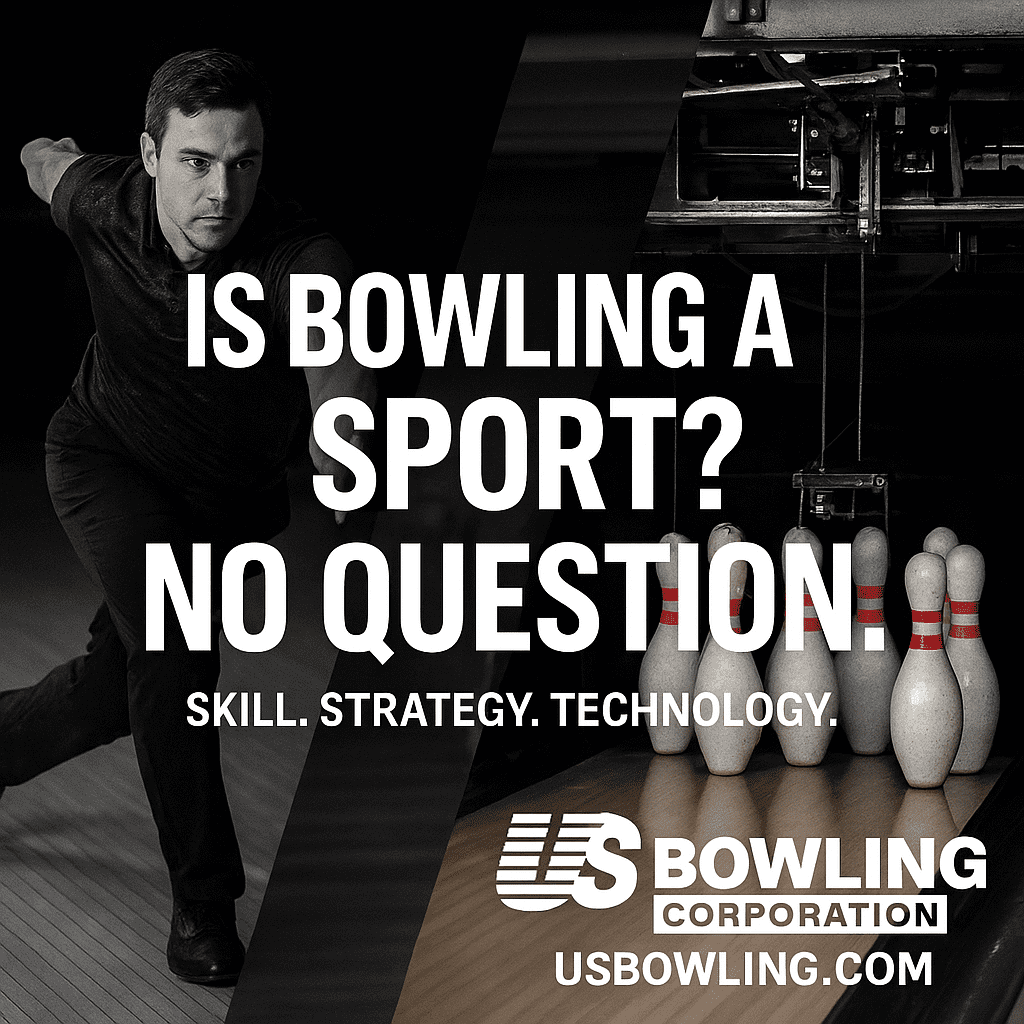
For decades, bowling has carried a curious dual identity: part serious competition, part social entertainment. It’s one of the few pastimes where professional athletes and weekend hobbyists share the same playing space — a lane, a ball, and ten pins — yet have vastly different goals.
That mix of fun and skill has sparked an ongoing question: is bowling really a sport, or just a game?
Ask anyone who has spent time in a competitive league, or a bowler preparing for a PBA event, and the answer comes fast: bowling is absolutely a sport — one that demands precision, consistency, strategy, and mental endurance. But to understand why, we have to look at what defines a sport, how bowling fits that definition, and how technology and innovation (like the modern US Bowling String Pinsetter System) are shaping its future.
What Defines a Sport?
By most accepted definitions, a sport is an activity that:
-
Requires physical skill and exertion,
-
Involves competition, and
-
Operates under a standardized set of rules.
Bowling checks all three boxes — even if its physicality looks different from running, swimming, or football.
The physical component of bowling comes in the form of precision movement: controlling balance, timing, release, and follow-through to deliver the ball consistently along a 60-foot lane. Repetition, accuracy, and power are developed through training and practice — just like in golf, archery, or baseball pitching.
Meanwhile, competition is deeply ingrained in bowling culture. Leagues, tournaments, and national ranking systems give players structured opportunities to compete under clear, measurable rules. In this sense, bowling’s infrastructure mirrors traditional Olympic sports, even if its accessibility makes it seem more recreational on the surface.
The Physical Side of Bowling
Anyone who has bowled for several games in a row knows it’s not effortless. A single delivery activates a surprising number of muscle groups — from the legs that drive balance and momentum, to the core that stabilizes the body, and the arm, wrist, and fingers that control the ball’s spin and direction.
Elite bowlers, especially those competing in high-level tournaments, often develop conditioning routines that resemble those of golfers or tennis players. Strength, flexibility, and balance training are essential to prevent fatigue and repetitive stress injuries.
Even more critical, though, is muscle memory. Each frame demands the same sequence of steps and release timing. Any inconsistency — even as subtle as wrist angle or foot placement — can change the ball’s path by inches, turning a strike into a split.
This is why professional bowlers often spend hours each week fine-tuning their physical form, experimenting with timing adjustments, and analyzing video of their approach. Like all serious athletes, they’re in a constant pursuit of perfect consistency.
The Mental Game
Physical control might start the process, but bowling is also one of the most psychologically demanding sports in existence.
Consider the typical competitive environment: a bowler has only a few seconds to make each throw, in silence, while knowing that one mistake can cost the match. Every lane plays slightly differently. Oil patterns shift subtly over time, requiring constant readjustment in speed, target, and release angle.
This blend of focus, strategy, and composure under pressure defines the mental side of bowling — one that separates casual players from serious athletes.
Many competitive bowlers use visualization techniques, breathing exercises, and even sports psychology training to prepare for tournaments. The mental toughness needed to maintain consistency over multiple games, across multiple days, is no less demanding than in golf, darts, or shooting competitions.
The Structure of Competition
The world of competitive bowling is far more organized and standardized than many realize. The United States Bowling Congress (USBC) governs official rules, lane conditions, and scoring systems across the U.S., ensuring that bowlers at every level play under consistent regulations.
Leagues, tournaments, and professional tours — like those operated by the Professional Bowlers Association (PBA) — follow strict criteria for lane oil patterns, equipment specs, and scoring. In international events, such as the World Bowling Championships, lane conditions are calibrated within thousandths of an inch.
Bowling also supports youth, collegiate, and senior divisions, allowing players to advance through structured competition — a clear hallmark of organized sport.
And while bowling has not yet been added to the permanent Olympic program, it has featured in the World Games and other international competitions recognized by the International Olympic Committee.
Bowling’s Evolution: From Wood to High-Tech
Just as materials and science have revolutionized tennis rackets, golf clubs, and bicycles, bowling technology has evolved dramatically over the past 70 years.
Early bowling lanes were made entirely of hardwood, which required frequent resurfacing and heavy maintenance. Today’s top facilities use high-durability synthetic lane systems, which provide more consistent ball reaction and require less upkeep.
The pinsetter, once a mechanical marvel of post-war engineering, has also advanced — and that’s where US Bowling Corporation has taken the lead.
The Rise of the String Pinsetter
For decades, traditional free-fall pinsetters dominated bowling centers around the world. While they provided a familiar look and sound, they were notoriously complex machines — requiring constant maintenance, high power usage, and specialized technicians.
US Bowling recognized that the future of bowling technology lay in innovation and sustainability. Their solution: the US Bowling String Pinsetter System.
Unlike traditional pinsetters, string pinsetters use a lightweight, efficient design where each pin is attached to a durable cord. After each ball, the machine quickly resets the pins without the need for a heavy, mechanical carousel or multiple motors.
The result is a system that:
-
Cuts power consumption by up to 70% compared to traditional pinsetters,
-
Reduces maintenance time and cost,
-
Improves reliability, and
-
Allows for faster frame turnover, increasing lane revenue for bowling centers.
Importantly, the string system doesn’t compromise gameplay integrity. US Bowling’s machines are designed to replicate authentic pin action — delivering the same excitement and challenge competitive bowlers expect.
The innovation has caught the attention of both operators and governing bodies. In recent years, organizations like the International Bowling Federation (IBF) have formally recognized string pin bowling as a legitimate format for sanctioned play, signaling a major shift in how the sport is defined at a professional level.
Why Bowling’s Accessibility Strengthens Its Claim as a Sport
One reason bowling’s “is it a sport?” debate persists is that anyone can do it — and that’s actually one of its greatest strengths.
Unlike many sports that require years of training or physical conditioning to participate, bowling is accessible to almost everyone. Children, seniors, and people with physical limitations can all play the same game on the same lane.
That universal accessibility sometimes leads to the misconception that bowling is too easy to be a sport. But accessibility and difficulty aren’t the same thing. Golf is widely accessible, yet few people would argue it’s not a sport. The same logic applies here: accessibility expands participation, not legitimacy.
Bowling’s inclusivity also contributes to its longevity as both a recreation and a competitive discipline. It bridges generations, connects communities, and provides a unique blend of entertainment and athletic pursuit.
The Role of Equipment in Athletic Performance
Another aspect that underscores bowling’s status as a sport is how equipment impacts performance.
The weight, coverstock, core design, and drilling layout of a bowling ball all affect its motion down the lane. Serious bowlers often maintain multiple balls for different oil conditions — similar to golfers choosing specific clubs for each shot.
Footwear, wrist supports, and even grip tape play subtle but significant roles in consistent execution.
And perhaps most crucially, the lane surface and pinsetter systems — like those engineered by US Bowling — influence the quality and fairness of competition. When lane conditions and equipment are standardized, the outcome depends solely on player skill, not luck.
That alignment between human ability and technological consistency is the hallmark of any legitimate sport.
The Business Side: Bowling as a Sustainable Sporting Industry
Bowling’s global reach is massive. There are more than 100 million bowlers worldwide, spanning over 90 countries. In the United States alone, tens of thousands of centers operate as community hubs, entertainment venues, and competitive arenas.
This combination of recreation and sport has made bowling one of the most sustainable segments of the amusement industry.
For bowling center owners, embracing modern equipment such as US Bowling’s string pinsetters isn’t just about maintenance savings — it’s about staying aligned with the direction of the sport.
By investing in reliable, tournament-grade systems, operators ensure that their lanes meet professional standards while appealing to recreational bowlers who value a high-quality experience.
How Innovation Keeps Bowling Competitive
Technology has always shaped how sports evolve. From instant replay in football to aerodynamic gear in cycling, innovation drives precision and performance.
In bowling, advances in lane materials, oil pattern control, and pinsetter design have transformed the game into a modern, sustainable sport that fits both competitive and entertainment markets.
US Bowling continues to lead that charge, developing equipment that bridges tradition with future-ready efficiency. The company’s String Pinsetter System and AMF-style lane installations have become go-to solutions for new bowling centers and retrofits alike — proving that the sport’s next generation will be defined by smarter, more cost-effective technology.
Bowling in the Era of Esports and Data
As digital and virtual competition grow, bowling remains uniquely grounded in physical performance — but even it has embraced the data age.
Modern scoring systems track ball speed, rev rate, and launch angle, providing players with real-time feedback similar to analytics platforms used in baseball or golf.
Many centers now integrate camera-based coaching tools, allowing players to analyze their delivery and make targeted improvements. This data-driven approach reinforces the sport’s legitimacy while helping newcomers appreciate its complexity.
Why the Question Still Gets Asked
So if bowling meets every criterion of a sport — physicality, competition, rules, and strategy — why do some people still hesitate to call it one?
The answer likely lies in perception. Recreational bowling, often accompanied by food, drinks, and music, presents a casual image. But that casual atmosphere doesn’t negate its athletic foundation — it simply makes the sport more inviting.
Compare this to golf: a game of quiet concentration that’s also enjoyed socially, with players ranging from weekend duffers to PGA pros. Bowling follows the same path — a sport that thrives because it accommodates all skill levels.
The Verdict: Bowling Is a Sport — and a Smart One
By every reasonable definition, bowling qualifies as a sport: it requires physical skill, competitive focus, and strategic intelligence. It has professional leagues, international federations, and a governing body that regulates play.
It rewards dedication, punishes inconsistency, and offers measurable performance metrics. And like any true sport, it evolves — both through its athletes and through technology.
The innovations developed by companies like US Bowling Corporation aren’t just modern conveniences; they’re part of what keeps the sport alive, sustainable, and exciting. From string pinsetters that lower operational costs to custom lane installations that bring tournament-level quality to commercial centers, US Bowling continues to support the infrastructure that makes competitive play possible.
So, the next time someone asks, “Is bowling really a sport?” — the answer is simple:
✅ Yes — and it’s one that continues to push the boundaries of technology, precision, and performance.
About US Bowling Corporation
US Bowling Corporation is a leading manufacturer and installer of complete bowling systems, including string pinsetters, custom lanes, scoring systems, and furniture. From new center builds to modernizations, US Bowling provides turnkey solutions that blend innovation, reliability, and style — helping proprietors create next-generation bowling experiences for players of all levels.


